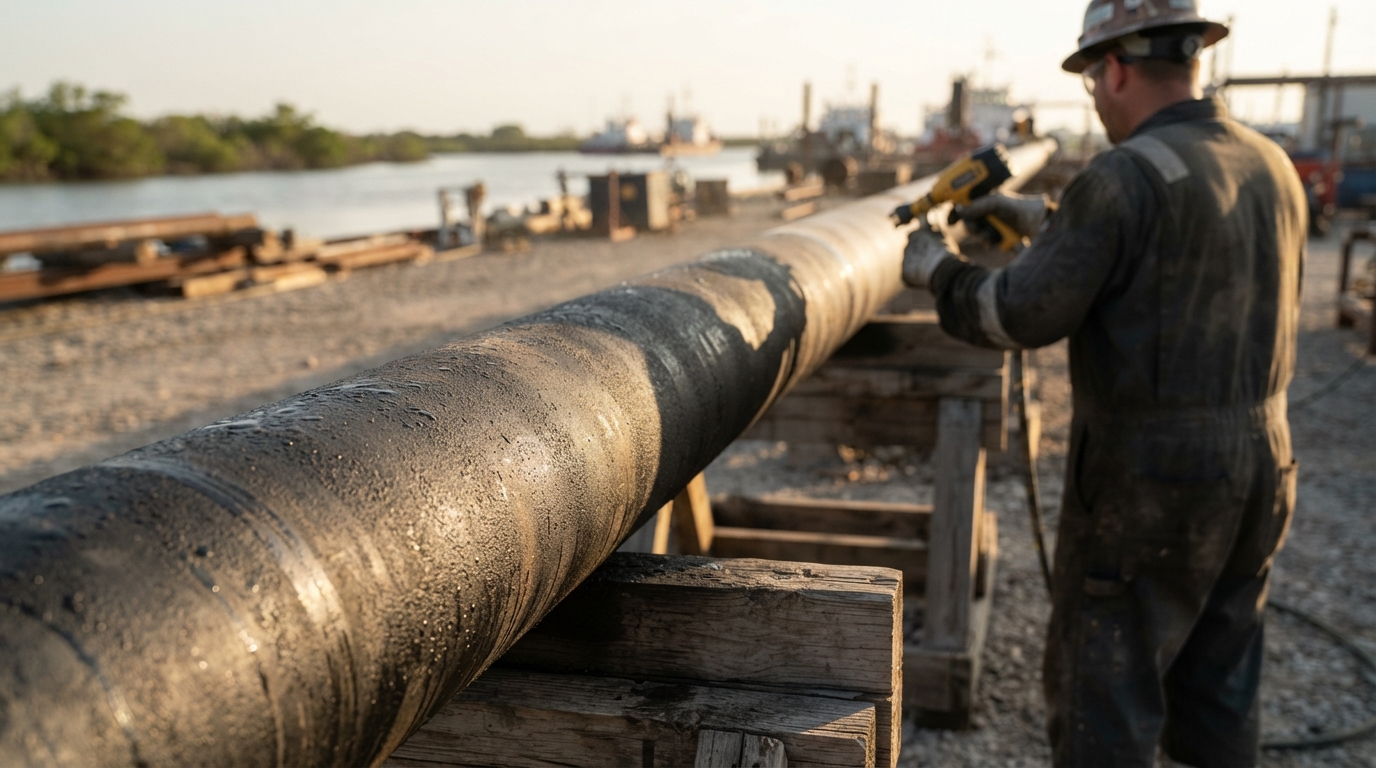

• Splash zone coatings protect pipe and structural surfaces exposed to constant moisture, wave action, and tidal cycling near Franklin, Louisiana’s waterways and marine facilities.
• Verified local expertise comes from proprietary elastomer coating systems bonded to metal during fabrication rather than applied as a simple paint layer.
• Durability depends on bonding conditions, coating thickness, and material selection matched to the exposure environment.
Property owners and facility managers searching for protection against corrosion in wet, high-impact zones need a coating system built for sustained water contact, not a standard exterior paint. Splash Zone Coatings Franklin LA refers to specialized elastomer-based protective systems designed to shield pipe and structural steel from the corrosive effects of constant splashing, tidal movement, and wave impact found along the Gulf Coast’s marine and industrial waterfront environments. These systems are engineered for structures where standard coatings fail quickly due to abrasion and moisture cycling.
What Splash Zone Exposure Does to Unprotected Metal
The splash zone is the area of a structure that sits between the high and low tide lines, where metal is alternately wet and dry. This cycling accelerates oxidation far faster than areas that stay fully submerged or fully dry.
• Wave impact wears away thin coatings and paint films.
• Salt spray and moisture cycling accelerate rust formation on exposed steel.
• Structural movement can crack rigid coatings that lack flexibility.
Conventional repair methods such as welding are not always practical in these zones due to location, hot-work restrictions, and the presence of volatile chemicals nearby. A flexible elastomer coating applied during fabrication avoids many of those constraints while extending service life.
How Verified Coating Systems Are Applied
Franklin-based manufacturer Mark Tool & Rubber Co. Inc has built its reputation on proprietary elastomer coatings bonded directly to metal pipe to prevent corrosion in splash zones. According to industry reporting, the coating is applied at the plant near Franklin, Louisiana, to pipe of practically any length and diameter, with plant application during fabrication allowing for controlled bonding conditions that directly affect long-term adhesion and performance.
This plant-based approach differs meaningfully from field-applied paints or wraps:
| Application Method | Bonding Control | Typical Durability |
| Field-applied paint | Limited, weather-dependent | Short to moderate |
| Wrap or tape systems | Moderate, seam-dependent | Moderate |
| Plant-bonded elastomer coating | High, controlled environment | Extended, low maintenance |
The coating itself is engineered to resist the specific stresses of the splash zone. The proprietary coating bonds with metal pipe to prevent corrosion in splash zones, and the flexible coating withstands structural movement and heavy wave impact. Because the material stays flexible rather than rigid, it can absorb the repeated stress of tidal cycling without cracking or delaminating the way a brittle paint layer might.
Maintenance requirements are another factor worth understanding before selecting a coating system. The coating requires no routine maintenance and has excellent insulating properties, both thermal and electrical. For facilities managing large numbers of pipe assets, that reduced maintenance burden can offset higher upfront material and application costs over the structure’s service life.
For broader context on how coastal Louisiana infrastructure is affected by moisture exposure and marine environments, the Louisiana Coastal Protection and Restoration Authority publishes guidance on infrastructure resilience along the state’s working coastline, which shares many of the same exposure conditions that drive demand for durable splash zone protection.
Matching Coating Thickness to Project Conditions
No two installations face identical exposure. Selecting the right coating thickness and formulation depends on several project-specific variables:
1. Pipe or structure dimensions, including length and diameter.
2. Local exposure conditions, such as wave height and tidal range.
3. Expected project timeline and installation environment.
4. Long-term performance goals, including insulating or thermal requirements.
A qualified applicator should review these variables before recommending a specification. The team can review pipe dimensions, exposure conditions, and project timeline to recommend the right product and thickness for the application. Skipping this step often leads to premature coating failure, particularly in zones with heavy wave action or structural flexing.
Frequently Asked Questions
What makes splash zone coatings different from standard industrial paint? Splash zone coatings are formulated as flexible elastomers bonded to metal, built to withstand constant wetting, wave impact, and structural movement rather than simply providing a surface color or basic rust barrier.
Where are these coatings typically applied? Application takes place at the plant near Franklin, Louisiana, as well as at facilities in California and Japan, and can accommodate pipe of practically any length and diameter.
Do splash zone coatings require ongoing upkeep after installation? No routine maintenance is required, and the coating offers strong thermal and electrical insulating properties.
Why does plant application matter compared to field application? Plant application during fabrication allows for controlled bonding conditions, which directly affects long-term adhesion and performance compared to coatings applied on-site under variable weather and access constraints.
Selecting the right splash zone protection comes down to understanding exposure conditions, bonding methods, and long-term maintenance expectations before a project begins. Facility managers evaluating pipe or structural coating options in Franklin can review project specifications with Mark Tool & Rubber Co. Inc, whose facility has focused on elastomer-based splash zone protection for pipe used in marine and industrial settings.